What is Generative Engine Optimization (GEO)? The Complete Guide to AI Search Visibility
The digital marketing landscape has undergone a seismic shift . With 800 million weekly active users now using ChatGPT and AI-powered search handling over 2.5 billion queries daily, traditional SEO strategies alone are no longer sufficient. Enter Generative Engine Optimization (GEO)—the revolutionary approach to ensuring your brand appears in AI-generated responses across ChatGPT, Perplexity, Google AI Overviews, and other generative platforms.
Table of Contents
- What is Generative Engine Optimization (GEO)?
- GEO vs. SEO: Understanding the Critical Differences
- Why GEO Matters More Than Ever
- How AI Search Engines Actually Work
- 10 Proven GEO Strategies That Work
- How to Measure Your GEO Performance
- Industry-Specific GEO Tactics
- 7 Common GEO Mistakes to Avoid
- The Future of GEO: What's Coming
- Getting Started with GEO Today
What is Generative Engine Optimization (GEO)?
Generative Engine Optimization (GEO) is the practice of optimizing your digital content, brand presence, and online authority to maximize visibility and citations within AI-powered search engines and large language models (LLMs). Unlike traditional SEO, which focuses on ranking in search engine results pages (SERPs), GEO ensures your brand, products, and expertise are referenced, cited, and recommended when users query AI platforms like ChatGPT, Perplexity AI, Google Gemini, Microsoft Copilot, and Claude.
The Core Objective of GEO
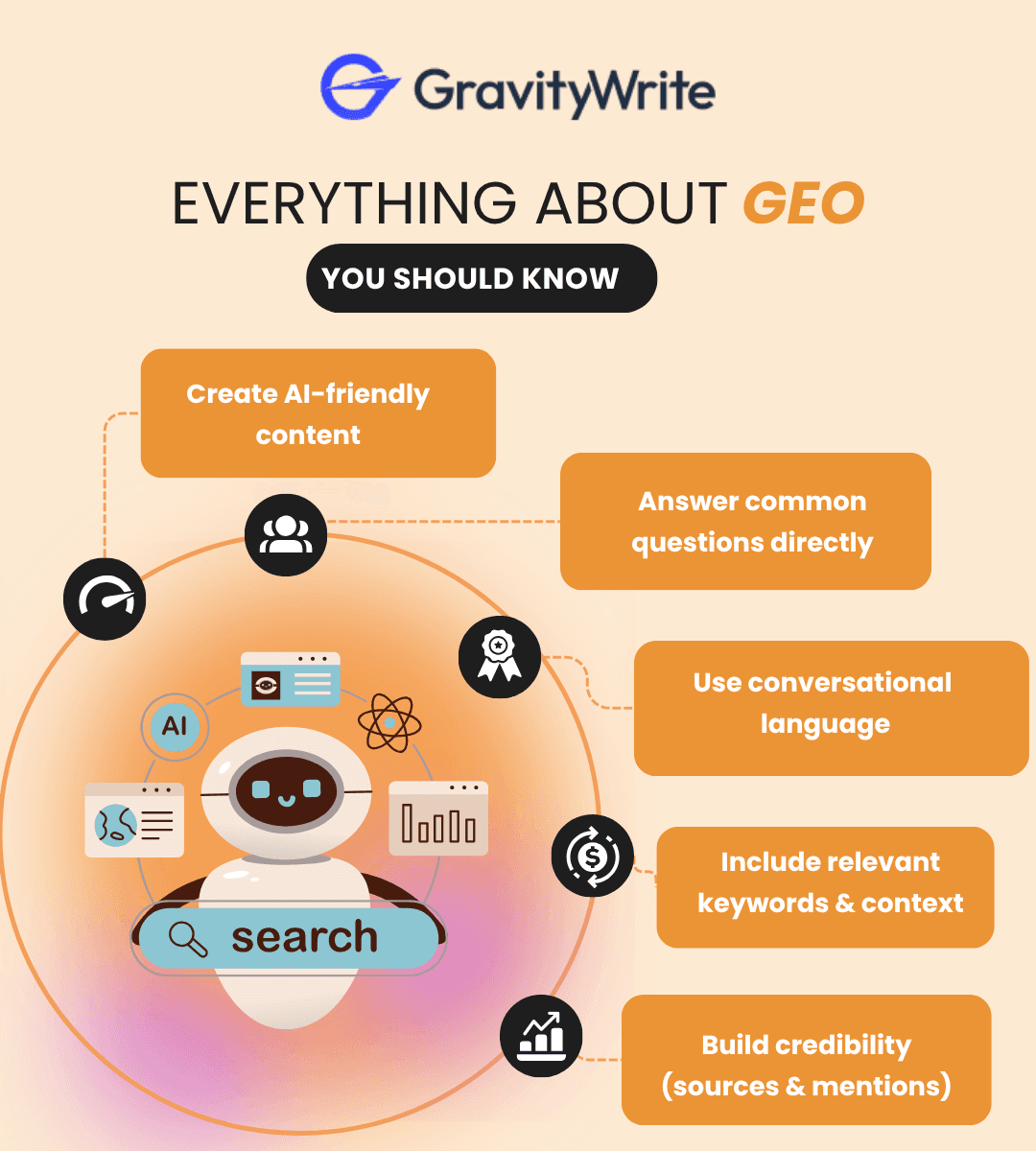
At its essence, GEO aims to position your brand as a trusted, authoritative source that AI models naturally cite when generating responses. This requires a fundamentally different approach than traditional SEO because AI engines don't simply rank pages—they synthesize information from multiple sources to create original, conversational responses.
When someone asks ChatGPT "What are the best GEO services for e-commerce businesses?" or queries Perplexity about "how to improve AI search visibility," your goal is to be among the sources the AI references, quotes, or recommends. This visibility translates directly into brand awareness, website traffic, and ultimately, conversions.
Key Components of GEO
Effective GEO encompasses several interconnected elements:
- Content Optimization: Structuring content in formats that AI models can easily parse, understand, and cite
- Authority Building: Establishing your brand as a credible source through backlinks, mentions, and citations across authoritative platforms
- Entity Recognition: Ensuring AI models recognize your brand, products, and key personnel as distinct entities
- Conversational Relevance: Creating content that answers natural language queries in the way users actually ask questions
- Citation Optimization: Structuring information to increase the likelihood of being cited as a source
- Multi-Platform Presence: Building visibility across the diverse data sources that train and inform AI models
💡 Pro Tip:
GEO isn't about gaming AI systems—it's about genuinely becoming the authoritative source in your niche that AI models naturally want to reference. Quality and expertise remain paramount.
GEO vs. SEO: Understanding the Critical Differences
While GEO and SEO share common foundations—both aim to increase online visibility—they differ fundamentally in approach, tactics, and measurement. Understanding these differences is crucial for developing an effective integrated strategy.
How GEO and SEO Are Similar
Before diving into differences, let's acknowledge the significant overlap:
- Content Quality: Both demand high-quality, accurate, and valuable content that serves user needs
- E-E-A-T Principles: Experience, Expertise, Authoritativeness, and Trustworthiness matter for both
- Technical Foundation: Fast loading times, mobile optimization, and clean site architecture benefit both
- Authority Signals: Backlinks, brand mentions, and citations strengthen both SEO and GEO
- User Intent: Understanding what users are searching for remains central to both disciplines
- Structured Data: Schema markup helps both search engines and AI models understand your content
Critical Differences Between GEO and SEO
| Aspect | Traditional SEO | Generative Engine Optimization (GEO) |
|---|---|---|
| Primary Goal | Rank high in search results pages | Be cited and recommended in AI-generated responses |
| Success Metric | Keyword rankings, organic traffic, click-through rate | Citation frequency, share of voice in AI responses, referral traffic from AI platforms |
| Content Format | Optimized for human readers and crawler bots | Optimized for natural language processing and information synthesis |
| Keyword Strategy | Exact-match keywords, search volume focus | Conversational queries, semantic relationships, contextual relevance |
| User Journey | User clicks through to your website | User may receive answer without clicking (zero-click), but brand awareness increases |
| Competition | Competing for 10 organic positions on page one | Competing to be among 3-5 sources cited in AI response |
Why You Need Both SEO and GEO
The most successful digital marketing strategies integrate both SEO and GEO. Here's why:
Traditional search engines aren't disappearing. Google still processes over 13.7 billion searches daily, and many users still prefer traditional search for certain query types. Abandoning SEO would mean losing access to this massive audience.
AI platforms drive different user behavior. Users who query ChatGPT or Perplexity often have different intent than those using Google. They're typically seeking conversational answers, comparisons, or synthesized information rather than a list of links to explore.
SEO builds the foundation for GEO. Many GEO best practices—authoritative backlinks, structured content, technical excellence—are rooted in solid SEO fundamentals. Strong SEO performance often correlates with better GEO visibility.
Diversification reduces risk. Relying solely on one channel (whether traditional search or AI platforms) exposes your business to algorithm changes, platform shifts, and market disruptions. A balanced approach provides stability.
📊 Data Point:
Businesses that integrate both SEO and GEO strategies see an average of 43% more total organic visibility compared to those focusing on SEO alone, according to recent industry research.
Why GEO Matters More Than Ever
The case for prioritizing GEO has never been stronger. Multiple converging trends make the inflection point where GEO transitions from "nice to have" to "business critical."
The Explosive Growth of AI Search
The numbers tell a compelling story:
- 800 million weekly active users on ChatGPT (doubled from 400 million earlier this year)
- 2.5 billion daily prompts processed by ChatGPT Search alone
- 38% of US adults used generative AI at least once
- 858% year-over-year growth in Perplexity AI search volume
- 10 million monthly active users on Perplexity AI
- 60% of searches on AI platforms result in zero-click outcomes (user gets answer without visiting a website)
These aren't experimental technologies anymore—they're mainstream search behaviors that are reshaping how people discover information, products, and services online.
The Decline of Traditional Search Traffic
As AI search grows, traditional search is experiencing measurable decline:
- Gartner predicts 25% reduction in traditional search volume by 2026
- Organic search traffic expected to decrease by over 50% as consumers embrace AI-powered alternatives
- 54% decrease in click-through rates from Google search results due to AI Overviews and featured snippets
- 79% of consumers expected to use AI-enhanced search within the next year
- 70% of users already trust generative AI search results
This isn't speculation—it's happening now. Businesses that fail to adapt risk losing visibility as their target audience migrates to AI platforms.
🎯 Bottom Line:
GEO isn't about preparing for the future—it's about competing effectively in the present. Your competitors are already being cited in AI responses. The question is whether you'll join them or be left behind.
How AI Search Engines Actually Work
To optimize for AI engines effectively, you need to understand how they function under the hood. While each platform has unique characteristics, they share common principles.
The AI Search Process: From Query to Response
When a user submits a query to an AI search engine, several steps occur in milliseconds:
- Query Understanding: The AI analyzes the user's question to understand intent, context, and what type of answer would be most helpful
- Information Retrieval: The system searches its training data, real-time web results, and proprietary databases for relevant information
- Source Evaluation: The AI assesses source credibility, relevance, and reliability based on multiple signals
- Information Synthesis: The system combines information from multiple sources to create a comprehensive, original response
- Response Generation: The AI generates natural language text that directly answers the query
- Citation Selection: The system determines which sources to cite (if any) based on contribution to the answer
What Makes a Source "Citable" to AI Engines
AI platforms don't cite sources randomly. They prioritize sources that demonstrate specific characteristics:
Authority Signals:
- • Backlinks from established, trusted domains
- • Mentions in reputable publications and academic sources
- • Author credentials and expertise indicators
- • Domain age and historical trustworthiness
- • Presence in knowledge graphs and structured databases
Content Quality Indicators:
- • Clear, well-structured information that's easy to parse
- • Original research, data, or unique insights
- • Comprehensive coverage of topics
- • Regular content updates showing currency
- • Factual accuracy and consistency with other trusted sources
Technical Factors:
- • Structured data markup (Schema.org)
- • Clean HTML structure with semantic tags
- • Fast loading times and accessibility
- • Mobile-friendly design
- • Secure HTTPS connection
10 Proven GEO Strategies That Work
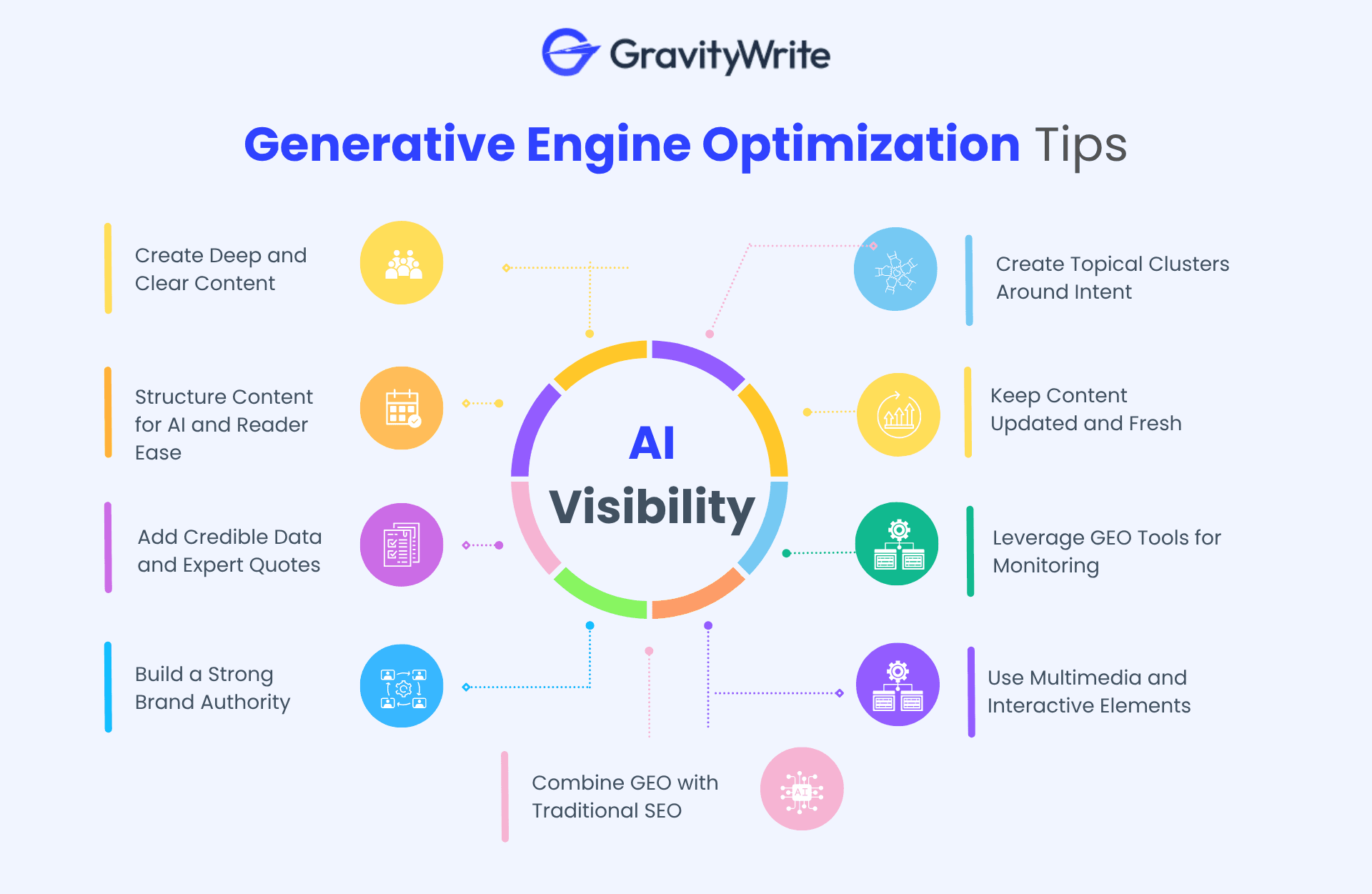
Now that you understand the fundamentals, let's dive into actionable strategies you can implement immediately to improve your GEO performance.
1. Create AI-Friendly Content Structures
AI engines parse and understand content differently than human readers. Structure your content to make it easy for AI to extract and cite:
- • Use Clear Definitions: Start articles with concise, quotable definitions
- • Implement FAQ Sections: Questions and answers map directly to how users query AI platforms
- • Include Statistics and Data: AI engines love citing specific numbers
- • Create Comparison Tables: Structured comparisons are highly citable
- • Write Quotable Insights: Include short, impactful statements that AI can easily extract
2. Build Entity Recognition and Brand Authority
AI models need to recognize your brand as a distinct entity before they'll cite you:
- • Claim and optimize knowledge panels
- • Maintain consistent NAP (Name, Address, Phone) information
- • Implement Organization schema markup
- • Create detailed author profiles with credentials
- • Get mentioned in authoritative publications
3. Optimize for Conversational Queries
People ask AI platforms questions differently than they type into Google:
- • Target long-tail conversational phrases
- • Use natural, conversational language
- • Answer "why" and "how" questions
- • Provide context and nuance
- • Include follow-up questions
4. Build High-Authority Backlinks and Citations
Focus on sources that AI models trust:
- • Academic institutions (.edu domains)
- • Government websites (.gov domains)
- • Major news publications
- • Industry-specific authoritative sites
- • Professional associations
5. Leverage Structured Data and Schema Markup
Schema markup helps AI engines understand your content's meaning:
- • Article Schema for blog posts
- • FAQ Schema for Q&A content
- • HowTo Schema for instructional content
- • Organization Schema for company information
- • Product Schema for e-commerce
🚀 Quick Win:
Start with strategy #1 (AI-friendly content structures) and #3 (conversational queries). These require no technical implementation and can be applied to existing content immediately. Learn how our GEO services can accelerate your results.
How to Measure Your GEO Performance
Unlike traditional SEO with established metrics like keyword rankings and organic traffic, GEO measurement is still evolving. However, several key performance indicators (KPIs) provide valuable insights.
Primary GEO Metrics
1. Citation Frequency
How often your brand, website, or content is cited in AI-generated responses.
How to measure: Manually query AI platforms with target keywords monthly and document citations.
2. Share of Voice in AI Responses
Your brand's presence compared to competitors in AI-generated answers.
How to measure: Calculate what percentage of queries mention your brand vs. competitors.
3. AI Referral Traffic
Website visits originating from AI platforms.
How to measure: Check referral traffic from chatgpt.com, perplexity.ai in Google Analytics.
4. Brand Mention Sentiment
Whether AI platforms describe your brand positively, neutrally, or negatively.
How to measure: Analyze the tone and context of AI-generated mentions.
📈 Realistic Expectations:
GEO is a long-term strategy. Expect to see measurable improvements in 3-6 months, with significant results in 6-12 months. Early wins may come from long-tail queries before you rank for competitive head terms.
Industry-Specific GEO Tactics
While core GEO principles apply universally, different industries benefit from tailored approaches.
E-Commerce and Retail
Key Challenges: Product recommendations, comparison queries, "best of" lists
Winning Tactics:
- • Implement comprehensive Product schema markup
- • Create detailed buying guides
- • Publish product comparison content
- • Include specific product specifications
- • Showcase customer reviews with Review schema
SaaS and Technology
Key Challenges: Software comparisons, feature explanations, use case matching
Winning Tactics:
- • Create comprehensive feature documentation
- • Publish integration guides and API documentation
- • Develop use case studies for different industries
- • Create comparison pages
- • Publish technical whitepapers
Local Businesses
Key Challenges: Geographic relevance, "near me" queries, local recommendations
Winning Tactics:
- • Optimize Google Business Profile completely
- • Implement LocalBusiness schema with complete NAP
- • Create location-specific content pages
- • Build citations in local directories
- • Encourage customer reviews across platforms
7 Common GEO Mistakes to Avoid
As businesses rush to adopt GEO, certain mistakes appear repeatedly. Avoid these pitfalls:
1. Treating GEO as a Replacement for SEO
The Mistake: Abandoning traditional SEO entirely to focus on GEO.
Why It's Wrong: Traditional search still drives massive traffic. The two strategies complement each other.
The Fix: Integrate GEO into your existing SEO strategy rather than replacing it.
2. Focusing Only on ChatGPT
The Mistake: Optimizing exclusively for ChatGPT while ignoring other platforms.
Why It's Wrong: Different AI platforms have different user bases and use cases.
The Fix: Test your visibility across multiple AI platforms and optimize for all major players.
3. Expecting Immediate Results
The Mistake: Implementing GEO tactics and expecting to appear in AI responses within days.
Why It's Wrong: Building authority and establishing entity recognition takes time.
The Fix: Set realistic timelines (3-6 months for initial results) and focus on consistent effort.
4. Creating Content for AI Instead of Humans
The Mistake: Writing in an unnatural style aimed at "gaming" AI systems.
Why It's Wrong: AI models are trained to recognize and value content that serves human needs.
The Fix: Write for humans first, then optimize for AI. Quality remains paramount.
The Future of GEO: What's Coming and Beyond
GEO is evolving rapidly. Here's what to watch for:
AI Search Will Become More Personalized
AI platforms are moving toward personalized responses based on user history, preferences, and context.
- • Different users may receive different citations for the same query
- • Building relationships with users becomes more valuable
- • Consistent brand messaging across touchpoints matters more
Multi-Modal Search Will Dominate
AI search is expanding beyond text to include images, video, and voice:
- • Image optimization for AI image search
- • Video content with transcripts for AI to reference
- • Voice search optimization for AI assistants
Specialized AI Engines Will Emerge
Industry-specific AI search platforms are launching:
- • Medical AI search engines
- • Legal research AI platforms
- • Financial analysis AI tools
- • Each will require specialized optimization strategies
🔮 Prediction:
By late 2026, GEO will be as established and essential as SEO is today, with dedicated tools, agencies, and best practices. The businesses investing in GEO now will have significant competitive advantages.
Getting Started with GEO Today
Ready to implement GEO? Here's your action plan:
Week 1: Establish Your Baseline
- Create a list of 20-30 target queries relevant to your business
- Query ChatGPT, Perplexity, and Google AI Overviews for each
- Document current visibility (are you cited? are competitors?)
- Identify gaps and opportunities
Week 2: Audit Your Technical Foundation
- Run a technical SEO audit
- Check structured data implementation
- Verify Core Web Vitals performance
- Ensure mobile optimization
- Fix any critical technical issues
Week 3-4: Optimize Existing Content
- Identify your top 10 most important pages
- Add clear definitions and quotable insights
- Implement relevant schema markup
- Add FAQ sections with conversational questions
- Update with fresh data and statistics
Month 2+: Build Authority and Create Content
- Claim and optimize your Google Business Profile
- Implement Organization schema sitewide
- Start outreach for high-authority backlinks
- Develop a content calendar targeting conversational queries
- Create comprehensive guides and resources
🎯 Need Help Getting Started?
GEO can be complex, especially for businesses without dedicated marketing teams. Contact our team for a free AI visibility audit and personalized GEO strategy. We'll show you exactly where you stand and what to prioritize first.
Conclusion: The GEO Opportunity is Now
Generative Engine Optimization represents the most significant shift in digital marketing since the rise of mobile search. With 800 million weekly users on ChatGPT alone and traditional search traffic declining by double digits, the question isn't whether to invest in GEO—it's how quickly you can implement it.
The businesses that master GEO will enjoy compounding advantages: early mover advantage as citation patterns reinforce existing authorities, diversified traffic sources reducing dependence on any single platform, enhanced brand authority from being cited by AI as a trusted source, and future-proofed marketing as AI search continues to grow.
The strategies outlined in this guide provide a comprehensive roadmap, but remember: GEO is a marathon, not a sprint. Start with the fundamentals, measure your progress, and iterate based on results.
Most importantly, focus on genuinely becoming the authoritative source in your niche. AI engines are sophisticated enough to recognize and reward real expertise, comprehensive content, and authentic authority. There are no shortcuts, but the rewards for doing it right are substantial.
The future of search is here. The only question is whether you'll be visible in it.
About AI Site Optimization
AI Site Optimization specializes in helping businesses improve their visibility across AI-powered search platforms including ChatGPT, Perplexity, Google AI Overviews, and more. Our team of GEO experts has helped hundreds of businesses increase their AI citations and drive qualified traffic from generative platforms.
Related Articles
SEO vs GEO: Which Should You Prioritize ?
Understand the key differences between traditional SEO and GEO, and learn how to balance both strategies for maximum visibility.
The Complete Guide to GEO for E-Commerce Businesses
Learn how e-commerce businesses can optimize for AI search platforms to increase product visibility and drive sales.
GEO for SaaS Companies: Complete Implementation Guide
Discover how SaaS companies can leverage GEO to appear in AI-generated software recommendations and comparisons.